Saturday, March 10, 2012

When not to use WD-40


Details here:  http://diy.stackexchange.com/questions/6226/when-should-i-not-use-wd-40 

I know some drivers use WD-40 to de-squeak and lubricate carriage parts, particularly springs. As you'll read in this web site, WD-40 is not really a permanent lubricant. It's too thin for that purpose plus it *attracts* dirt. 


What it*is* good for is as a penetrant to unstick parts (although there are more effective ones like Kroil) and as a temporary lubricant to get you and your equipment to the time and place where you can use a more permanent, more appropriate lubricant. 

So far, for me, I find good quality spray silicone lasts fair long and does NOT attract dirt or even leave any visible trace (i.e. good for use on high quality polished carriage parts.) I mainly use it to quiet carriage leaf springs.


That said, I find most squeaks occur between metal and wood parts rather than metal on metal. In those cases, if practical, I make a washer or spacer out of a piece of polyethylene milk bottle or oil can plastic , loosen or separate the metal and wooden parts, slip the spacer in and re tighten any bolts or screws.


Usually this fix last forever....well, I can't actually swear to that since I haven't lived that long.

Monday, January 30, 2012

How to Hang a Bucket

Hanging buckets in wooden stalls has its problems.

One good solution to hanging buckets in a stall:

One steel chain repair link + one steel interlocking, straight gate carabiner = one almost indestructible bucket hanger. No more screw eyes to pull out. No more broken double end snaps. No more bucket hangers to bend or pull off. No more snaggiing tail hair. Buckets hang straight and are easy to remove.

Thursday, January 19, 2012

Horses with 8 Feet

From the Hellbrunn Schloss, Austria


An 8 footed Arab. This apparently was a real horse.

Another 8 footed horse was Sleipnir, ridden by the Norse God, Odin


Tuesday, December 20, 2011

Troika Speed


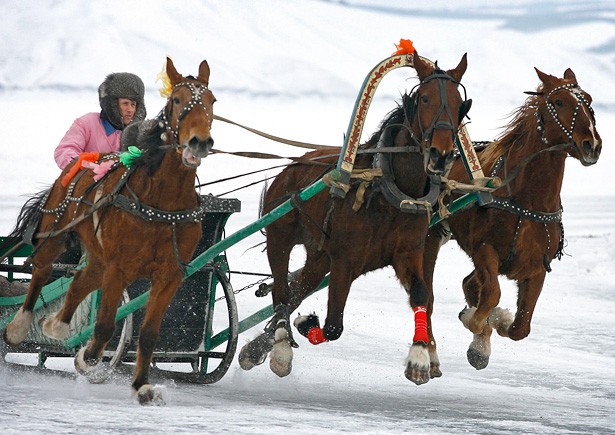
A troika, a three-horse drawn sledge, competes on the frozen Yenisey river during an amateur horse race near the settlement of Novosyolovo. The Ice Derby has been held in Novosyolovo annually at the end of each winter since 1969, drawing participants from the entire region.


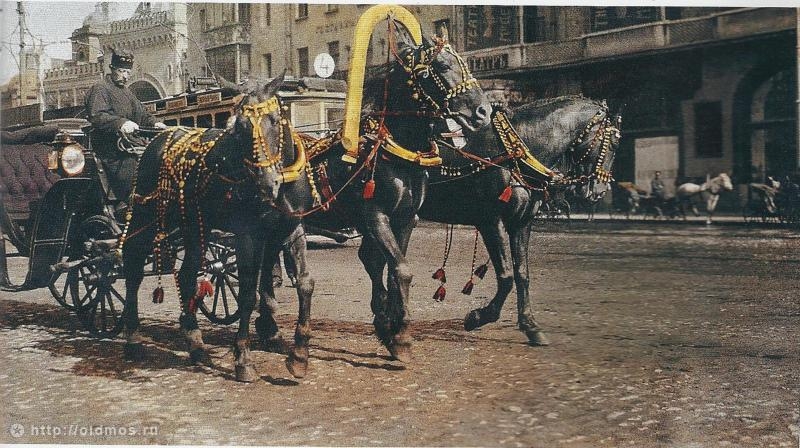
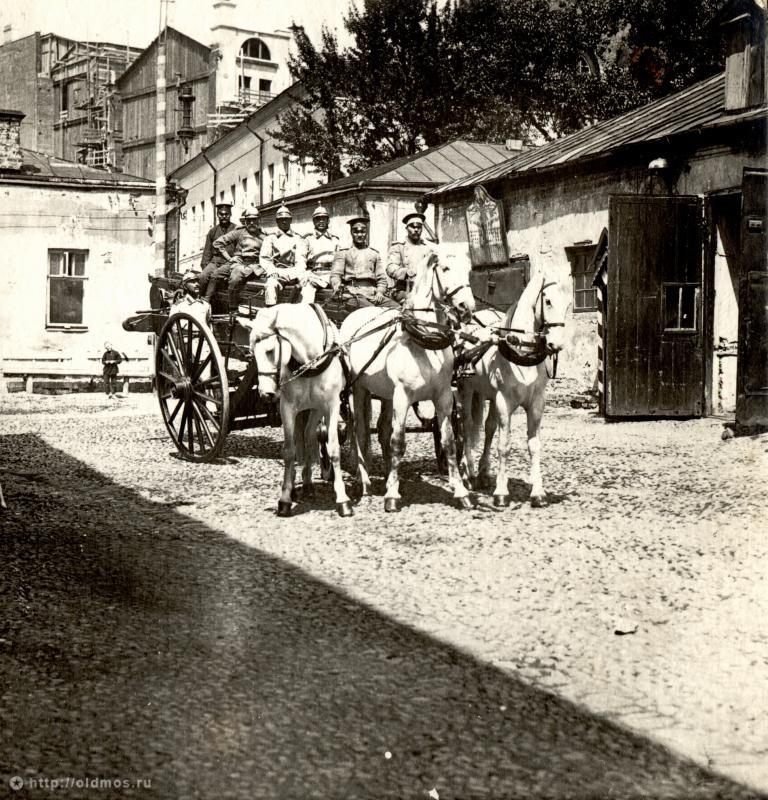
Troika Fire Department Horses


More great photos in this set


Monday, November 14, 2011

Tuesday, September 27, 2011

The Buggymobile


A 1905 Columbus High Wheel Runabout. A perfect example of the transition from the horse and buggy age to the age of the auto mobile. This is "buggymobile" had a twin cylinder 10 HP air cooled electric  motor under the seat. The hood is a false engine compartment. Notice all the 'artifacts' from the horse carriage construction. This vehicle will be auctioned off on October 7th in Hershey PA. It is expected to fetch between $60,000 and $80,000. It sold in 1905 for $750!

Friday, July 22, 2011

Update: Breeching Forces in the Extreme


Update: Consider using tug stops on the shafts of single's vehicles to help disperse the load from breeching by using some pressure on the saddle to help slow and stop the forward motion of the vehicle. As potentially beneficial as it may be to have as little 'weight' on the saddle most of the time, it may also prove to be beneficial in the long run to share some of the vehicle stopping forces between the saddle and the breeching. Thank you, Elsie Rodney, for pointing my thinking in that direction. 9-1-11


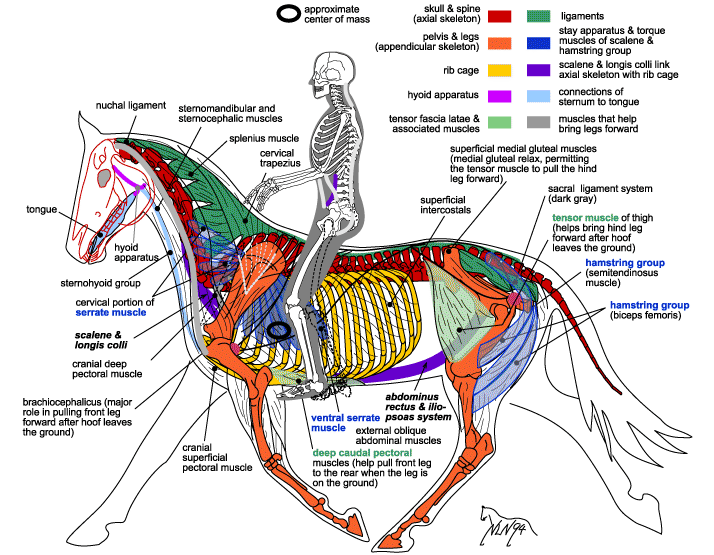
Consider the stresses placed on the sacroiliac joint and pelvis of the single driving horse. These structures play a primary role in the transfer of the power developed from the hind legs to propel the horse and carriage and humans forward, they also perform the integral function of transferring the weight of the carriage and humans via the breeching to the horse for braking purposes. Breeching forces at the extreme moments of performance may take these structures to and beyond their limit causing compounding damage over time.

For some perspective, consider the single standardbred race horse. There is NO braking force occurring in their performance. It’s all forward. Now visualize the single combined driving horse with several hundred pounds of vehicle and human weight with the breeching forces shoving the horse from behind in the extremes of full gallop turns on a side hill in a Combined Driving marathon obstacle. These forces are not always symmetrical or predictable to the horse. Imagine yourself running on uneven ground (i.e with each foot on a different elevation) when, out of nowhere, you are shoved to the side from an angle from behind. Do this enough ties and your chances of injury are quite high. It's not hard to imagine the high toll that is taken on the pelvic structures of the equine.

While the following concerns the sacroiliac joint and pelvis, it is similar to the injury cycle of other structures of the horse.

THE INJURY CYCLE – Initial Sprain or over stretch injury Pain and inflammation • Powerful muscle spasm to protect or guard the joint during this painful stage • Pain and inflammation resolve • Powerful muscle spasm remains holding the joint in an abnormal position • Increased stress through the joint, because it is rotated or sitting in an abnormal plane • Arthritic changes set in • Another bout of pain and inflammation occur due to the arthritis and the cycle REPEATS.
Each time the cycle repeats the muscles get tighter, further affecting the function of the sacroiliac joint, pelvis and spine. In summary, the initial sprain leads to a pelvic rotation, which leads to a loss of function. The horse then has to compensate for this rotation at the pelvis, placing abnormal stresses on a whole new set of joints and causing further problems.