Thursday, August 20, 2015


Saturday, August 8, 2015
Looking forward to the next horse
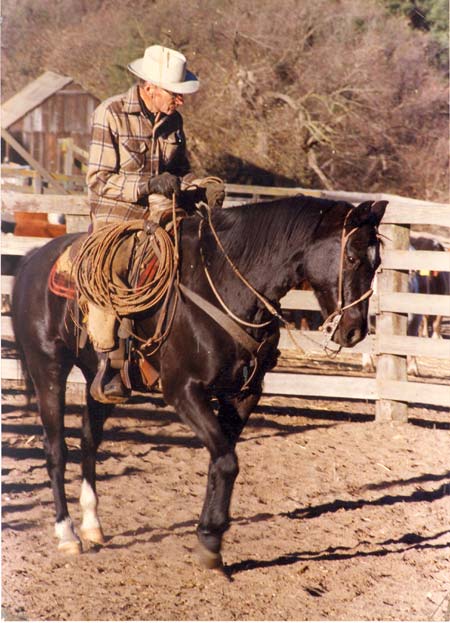
"It is hard to put a price on accepting that everything you think you know about horses may change with the very next horse."
From an article about Bill Dorrance by Verlyn Klinkenborg 'Death of a Legendary Horseman' - NY Times July 24, 1999 - http://www.nytimes.com/…/editorial-notebook-death-of-a-lege…
It is amazing to ponder that with all the time man has spent with horses and with all that has been studied and written about horses, there is always something new to be learned.
I am always looking forward to what the next horse has in store for me.
I am always looking forward to what the next horse has in store for me.
Bill Dorrance

Friday, July 10, 2015
Can it be driven?
I saw this set of tracks in my driveway today left from stone dust on the wheels of a Pacific Darmor that I had turned around by hand in order to hook the next horse of the day. I set some cones next to them and pondered this.....
Is it possible to actually make this turn?
The carriage did it with 35 cm clearance....
Training Level clearance.
 |
| Red = Front Track Green = Rear Track |
But can it be done with a horse or pony attached?
Where would the front feet have to be to make this?
It probably can not be done with a Training Level Horse except by pure luck and it might not be fair to even ask for it.
Monday, February 23, 2015
Allow for Mental Processing
Mental Processing
From: http://www.scienceofmotion.com/documents/the_meaning_of_life_pt3.html
At each level of the education, the horse reacts first protecting familiar locomotor patterns or muscle imbalance. If properly guided by the rider, the horse brain explores a new reflex combination. It is scary first from the horse point of view but also intriguing as the reflex combination renders the move or the gait, less uncomfortable or even easier.
The brain is simultaneously scared and interested. The brain is interested because of the physical comfort that the reflex combination provides. Basal nuclei, olivary nuclei, cerebellum, which are components of the brain monitoring the body situation, have registered the physical comfort associated with the move. The brain is simultaneously scared because the sensation is not familiar. At this point, the rider easily encourages or destroys the horse mental involvement. If the rider thinks in terms of submission, leadership, obedience to the aids, the rider annihilates the horse mental development. At the contrary, if the rider respects the horse’s mental processing and gives to the horse some processing time, let the horse explore errors and use the horse’s errors to reformulate the question, the rider develops the horse’s intelligence.
by Jean Luc Cornille
This is reflected in the way I teach:
by Jean Luc Cornille
This is reflected in the way I teach:
- Make it easy for the horse to guess the right answer.
- Guide him to a way of accomplishing what is asked of him that makes his work easier.
- Allow him to explore what works best. Do not force him. He will come to you.
- Give him enough repetition and enough processing time for him to recognize there is an easier way.
- Capitalize on the equine's evolutionary instinct to make the best use of the calories available. Horses want to be efficient.
- Our training job is made easier because the evolutionary appreciation for greater efficiency ultimately has meaning to a horse.
Related thought:
"When a motion is repeated slowly and accurately it becomes thoroughly ingrained in the muscle memory of the practitioner. The motion then becomes automatic, and conscious thought is no longer needed to perform it. This kind of programming cannot be obtained by fumbling through a technique. Rather, it must be repeated often and without mistakes. At first, this can only be done at slow tempos."
(Philip Sudo & Tobias Hurwitz, 2007)
(Philip Sudo & Tobias Hurwitz, 2007)
Saturday, January 17, 2015
Feeling, Timing, Balance
Glad he gave credit where it's due.
This is a pretty good explanation of what should be happening when you ride *or* drive!
Saturday, December 20, 2014
Learn to Smell it Coming
STAY CONNECTED
LEARN TO DRIVE BY FEEL
This could be a topic for another article or even a whole book, but suffice to say, one of the main factors to keep in mind is the connection to the horse. By connection I mean riding in presence; being aware of your horse and making him aware of you, through the use of aids at all times. I am not talking about micromanaging every motion of the horse, rather I am suggesting that by keeping the seat independent, moving with the horse, the hands light and rein aids flexible and keeping your calves lightly touching the horse’s side at all times, you can maintain mutual communication with your horse. In doing so you will become aware right away when he is startled by some movement or sound and instinctively reacting with flight. This way you can react more quickly to counter this reaction with a calm firming of the aids for just a moment; in other words, catching the spook before it becomes a run and assuring the horse that you are right there with him, protecting him and that he has nothing to fear.
~ From: Troy Griffith
Although the above quote is about riding, the concept certainly pertains to driving. However, the driver has fewer tools available to establish and maintain this connection and the connection perhaps is even more important and necessary than with riding *because* there is no physical bodily contact with the horse.

Drivers are readily tempted to attach their eyes to the horse in front of them. Why? Besides the fact it the horse is right there to look at, we rely primarily on our visual field for our survival data. Self preservation depends more than anything on the sense of sight. Our brain is wired to use sight as its primary sense.
The problem with this for maintaining the connection with the driving horse is that while we are looking at the horse, the horse is not looking back at us. He's looking the other direction and in fact is usually further limited by blinders on his bridle. There is no effective eye contact.
If one cultivates the skill of driving by feel, however, there is a definite tangible connection in both directions to the horse and from the horse. This connection is primarily made through the rein aid but the whip, the voice and one's body position and control also enter into the communication formula.
This skill is best developed by purposely looking away from the horse and devoting your mental resources to ascertain how it feels. Go so far as to close the eyes. Sounds perilous but, if the environment is controlled, it can be safely done. If anxious about it, take someone along who has their eyes open. As an alternative, simply blur the vision. Try this simple test: drive for 3 minutes without looking at the horse. One will quickly realize how time and resources are spent watching the horse! Set a long term goal of driving an entire dressage test without looking directly at the horse once.
Learn to cultivate the skill of treating the information at the peripheral edges of the visual field as if it were information in the very center. When looking up, ahead and around the corner, one can still see there is a bay horse with his ears up. One can gather useful information about tempo and rhythm through the feel on the vehicle. The bend of the horsecan be determined becasue of the relative position of hands. There is useful information about the degree of self carriage through the feel of the contact. There is ton of information out there to be used that can be gained through developing the sense of how it feels to drive.
In a sense, this information becomes almost more important for the driver because we have no bodily contact with the horse. If we develop our sense of driving feel, we can tell the instant he tenses or shortens a stride or pushes harder with on a hind leg to get out of tempo and rhythm. As my good friend and consummate driving teacher, Robin Groves, once said: " Learn to smell it coming." It can be done but it is an acquired skill that takes a lifetime to hone to perfection.
Monday, December 15, 2014

Subscribe to:
Posts (Atom)

 Posts
Posts

