Sunday, March 20, 2016
Saturday, March 12, 2016
The Remarkable Story
March 11, 2016 - It is truly remarkable that 64 mistreated Morgan horses were adopted by the Morgan Community in just over a month from Beth Lyn Hoskin's Eden Farm in western New York. My heartfelt gratitude goes out to the court appointed receivers who gave of their personal time and resources above and beyond what was required to help these animals. Sincere thanks to the Morgan owners who stepped up and took the horses back to their farms where they will know care and love like they have never had, To me it is a very moving chapter in teh story fo the Morgan Horse.
Thursday, February 18, 2016
Andrew McLean investigates Objective Dressage Judging
Andrew McLean investigates Objective Dressage Judging | The Horse Magazine – Australia's Leading Equestrian Magazine:
“Each element on the scale needs a fundamental definition. Take rhythm for example – every trainer and rider has different view of its fundamental definition. My own surveys of judges and trainers say rhythm is about regularity, fluidity, fluency, evenness and many other qualities. But there is a more important definition: “the horse keeps doing whatever it has been asked until asked otherwise.” This definition is old, because even Grisone mentioned it 455 years ago – the trend continued through Baucher, Steinbrecht, and as recently as Decarpentry and Oliveira last century. Today many trainers will stress this point, but it isn’t given enough consideration in judging. If they did, the rankings would change.”
“I think this ‘self-maintenance’ definition should be paramount in determining rhythm where the judge can see that the horse is not held in its speed by rider but is trained to remain in gait, tempo and stride length/height. The notion that the horse should ‘continue to keep going’, means that if the horse is seen to be held by the reins or rider’s leg in speed, straightness or outline, then it isn’t going ‘on its own’ – it isn’t in self-carriage and it’s bad for the horse’s mental well-being. Elements such as regularity are subsets of this notion. This has to be the fundamental definition of rhythm, for many reasons especially the horse’s mental welfare. It seems a relatively easy task to see whether or not a horse is going ‘on his own’. Also many issues that are seen as ‘contact’ issues are in fact rhythm issues (i.e. the open mouthed horse would run if you let go of the reins). Precisely sticking to a definition of rhythm as self-maintenance of speed would be a huge step in improving the welfare of dressage horses. It would significantly alter the positions of many riders at all levels of competition. It would make dressage riders better trainers.”

'via Blog this'
Monday, February 8, 2016
Using the Voice: An Experiment
Help me with this experiment. I'll post a summary of results at some point.
Sunday, October 11, 2015
Sandbox Lesson #3: Driving the Center-line
Driving the Center-line
Driving down the center-line occurs at least twice in every dressage test at every level. There is always a judge assessing your accuracy, sitting at "C". Practically above all else, they notice when you waiver or veer from a true line. If you are not perfectly straight, how can it be a ""10"? Why is it so difficult to be accurate on the Center-line? And how many drivers fudge this part of their tests?
One reason is that as soon as you turn down the line, the letter in back of you is out of your sight. You do not have eyes in back of your head to keep you and your horse directly lined up with it as you travel down the line.
One very simple practice technique we use at Green Meads Farm is to place three sets of cones on line, one pair at "D" which is on the line 10 meters from"A" and one pair at "X" in the center and one pair at "G", 10 meters from "C". These should be wider than cones gates you would use to practice or train for driving obstacles, especially the pair at "X" so that you can still drive the long diagonal lines. They just serve as a visual guide to help you stay on the line and to stay straight.
The pair of cones at "D" and "G" help guide you to start your trip down the center-line in the right place. By the time your horse's hind end passes thru the pair, he should be straight down the line. If you look closely at the photo you will see the hind end foot prints right between the cones in front of "A", right on the center-line.
These cones will help pretty dramatically to keep your repetitions very nearly the same so that when they are not present, your internal compass will have been honed and trained to rather instantly sense when you are about to not be exactly straight and you can make the tiniest adjustment to remain on a true course. Your wavering and veering and drifting will be minimized.
This same effect will occur in your horse(s). They will remain straighter over time as they begin to feel the straighter line occur again and again over time. Like pushing a wheelbarrow, it's easier to stay balanced and straight than it is to keep re-balancing and adjusting course. I believe it is much the same for the horses.
Thursday, August 20, 2015
Saturday, August 8, 2015
Looking forward to the next horse
"It is hard to put a price on accepting that everything you think you know about horses may change with the very next horse."
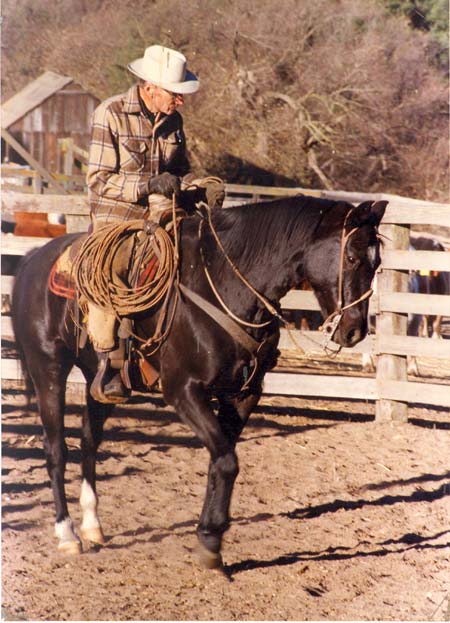
From an article about Bill Dorrance by Verlyn Klinkenborg 'Death of a Legendary Horseman' - NY Times July 24, 1999 - http://www.nytimes.com/…/editorial-notebook-death-of-a-lege…
It is amazing to ponder that with all the time man has spent with horses and with all that has been studied and written about horses, there is always something new to be learned.
I am always looking forward to what the next horse has in store for me.
Subscribe to:
Posts (Atom)