Showing posts with label Vehicles. Show all posts

Saturday, March 10, 2012

When not to use WD-40


Details here:  http://diy.stackexchange.com/questions/6226/when-should-i-not-use-wd-40 

I know some drivers use WD-40 to de-squeak and lubricate carriage parts, particularly springs. As you'll read in this web site, WD-40 is not really a permanent lubricant. It's too thin for that purpose plus it *attracts* dirt. 


What it*is* good for is as a penetrant to unstick parts (although there are more effective ones like Kroil) and as a temporary lubricant to get you and your equipment to the time and place where you can use a more permanent, more appropriate lubricant. 

So far, for me, I find good quality spray silicone lasts fair long and does NOT attract dirt or even leave any visible trace (i.e. good for use on high quality polished carriage parts.) I mainly use it to quiet carriage leaf springs.


That said, I find most squeaks occur between metal and wood parts rather than metal on metal. In those cases, if practical, I make a washer or spacer out of a piece of polyethylene milk bottle or oil can plastic , loosen or separate the metal and wooden parts, slip the spacer in and re tighten any bolts or screws.


Usually this fix last forever....well, I can't actually swear to that since I haven't lived that long.

Tuesday, December 20, 2011

Troika Speed


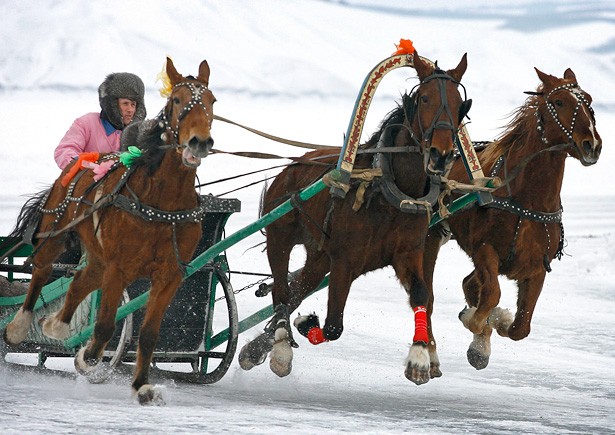
A troika, a three-horse drawn sledge, competes on the frozen Yenisey river during an amateur horse race near the settlement of Novosyolovo. The Ice Derby has been held in Novosyolovo annually at the end of each winter since 1969, drawing participants from the entire region.


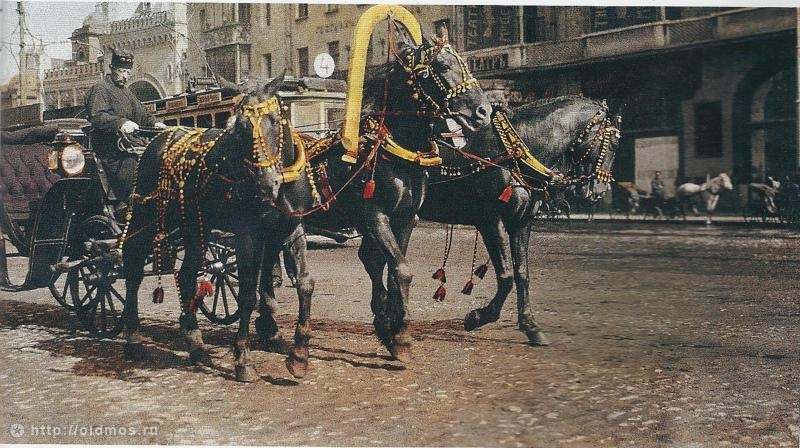
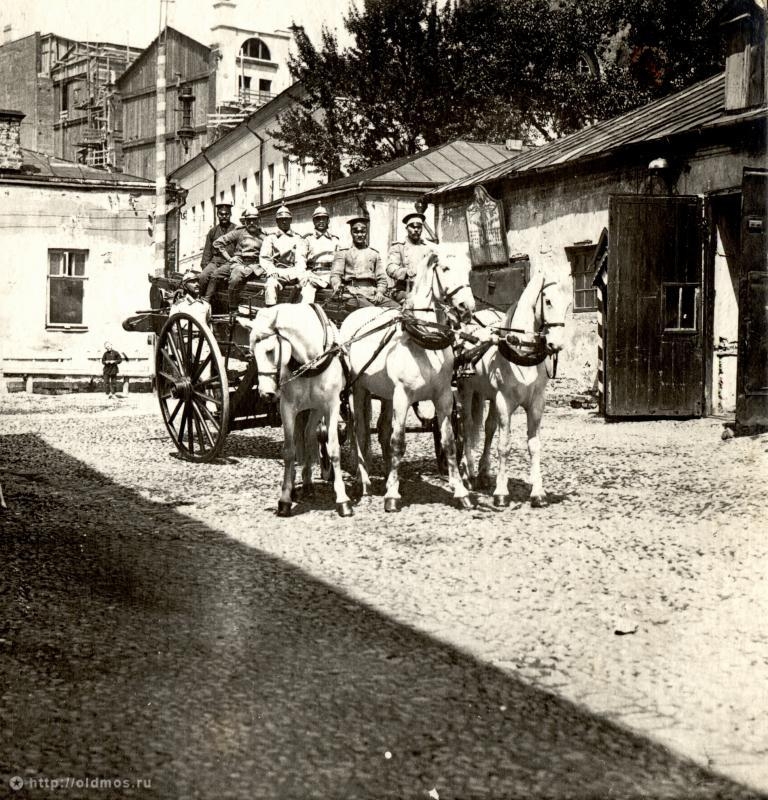
Troika Fire Department Horses


More great photos in this set


Friday, July 22, 2011

Update: Breeching Forces in the Extreme


Update: Consider using tug stops on the shafts of single's vehicles to help disperse the load from breeching by using some pressure on the saddle to help slow and stop the forward motion of the vehicle. As potentially beneficial as it may be to have as little 'weight' on the saddle most of the time, it may also prove to be beneficial in the long run to share some of the vehicle stopping forces between the saddle and the breeching. Thank you, Elsie Rodney, for pointing my thinking in that direction. 9-1-11


Consider the stresses placed on the sacroiliac joint and pelvis of the single driving horse. These structures play a primary role in the transfer of the power developed from the hind legs to propel the horse and carriage and humans forward, they also perform the integral function of transferring the weight of the carriage and humans via the breeching to the horse for braking purposes. Breeching forces at the extreme moments of performance may take these structures to and beyond their limit causing compounding damage over time.

For some perspective, consider the single standardbred race horse. There is NO braking force occurring in their performance. It’s all forward. Now visualize the single combined driving horse with several hundred pounds of vehicle and human weight with the breeching forces shoving the horse from behind in the extremes of full gallop turns on a side hill in a Combined Driving marathon obstacle. These forces are not always symmetrical or predictable to the horse. Imagine yourself running on uneven ground (i.e with each foot on a different elevation) when, out of nowhere, you are shoved to the side from an angle from behind. Do this enough ties and your chances of injury are quite high. It's not hard to imagine the high toll that is taken on the pelvic structures of the equine.

While the following concerns the sacroiliac joint and pelvis, it is similar to the injury cycle of other structures of the horse.

THE INJURY CYCLE – Initial Sprain or over stretch injury Pain and inflammation • Powerful muscle spasm to protect or guard the joint during this painful stage • Pain and inflammation resolve • Powerful muscle spasm remains holding the joint in an abnormal position • Increased stress through the joint, because it is rotated or sitting in an abnormal plane • Arthritic changes set in • Another bout of pain and inflammation occur due to the arthritis and the cycle REPEATS.
Each time the cycle repeats the muscles get tighter, further affecting the function of the sacroiliac joint, pelvis and spine. In summary, the initial sprain leads to a pelvic rotation, which leads to a loss of function. The horse then has to compensate for this rotation at the pelvis, placing abnormal stresses on a whole new set of joints and causing further problems.

Wednesday, March 23, 2011

From the Horse & Buggy to the Ford Model T


The wheel making sequence is particularly interesting. Also note how many bodies are involved in this assembly line process compared to today's assembly lines

Thursday, March 10, 2011

What's Old is New


Note the use of the carriage lamps, obviously state of the art at the time. The wooden spoke wheels and pneumatic tires look the same as many European carriages today. The seating is remarkably similar to Combined Driving vehicles of today as well. The top is a direct adaptation of a driving vehicle folding top. Gotta love the 'steam punk' dash! There are, no doubt, many other similarities if one could examine this car more closely.

Wednesday, January 20, 2010

Don't hook your horse like this!


This is not fair to the horse or to the people involved.

All participants are SO fortunate not to have gotten injured in this episode.

Unfortunately, it is scenarios like this that make business for trainers.

It is so unnecessary to go about it this way.

I can hardly count all the things that are unsafe and just plain wrong with this.

I do NOT want to get the call to fix this horse!

Monday, January 18, 2010

San Francisco 1906: video on the street


This film, originally thought to be from 1905 until David Kiehn with the Niles Essanay Silent Film Museum figured out exactly when it was shot. From New York trade papers announcing the film showing to the wet streets from recent heavy rainfall & shadows indicating time of year & actual weather and conditions on historical record, even when the cars were registered (he even knows who owned them and when the plates were issued!).. It was filmed only four days before the quake and shipped by train to NY for processing. Amazing but true! Music: "La Femme D'Argent " from the "Moon Safari" album by Air

Monday, March 30, 2009

Currier & Ives


Images to inspire sleigh rally turnouts for the Currier & Ives Class.


Friday, March 6, 2009

"Big Wheel " Chairs


Copy of a postcard found at the New Lebanon , NY Flea Market, Sunday Oct 27, 2002

A 3 Wheeler designed by Eliphalet Nott
1773-1866, American educator, inventor, and clergyman, b. Ashford, Conn. In 1804, Nott became president of Union College, a post he held for 62 years; he initiated an extensive building program and introduced a scientific course as an alternative to the traditional classical curriculum. He published a number of pamphlets on slavery, temperance, and education and contributed to science by his experiments with heat. Nott was granted over 30 patents and was the inventor of the first anthracite coal base-burner stove. (The Columbia Encyclopedia, Sixth Edition. 2001)

Recently I conducted a clinic in New Mexico and my host, Tom Phillips, had been in a motorcycle accident and broken his leg. He was wheel chair bound and got lots of kidding about still being able to drive and maybe he should hook his minis up to his chair.

There is nothing new under the sun.


Queen Victoria


Queen Victoria